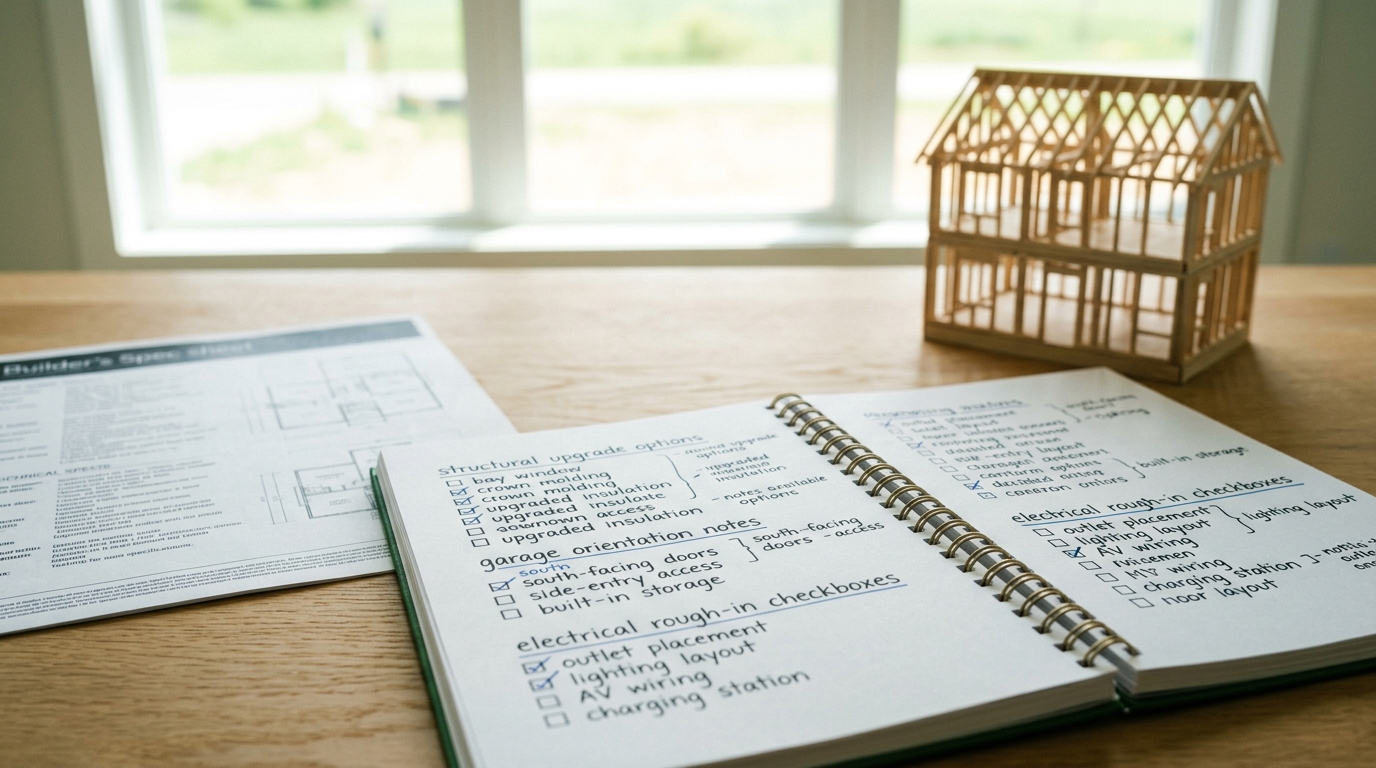
Before you sit down with a builder, write a concrete wish list that covers lot preferences, floor plan priorities, structural upgrades, finish levels, and deal-breaker must-haves. Buyers who arrive at a builder meeting with a documented list consistently get more accurate bids, avoid costly mid-build change orders, and reduce the decision fatigue that derails timelines.
New construction is one of the largest financial commitments most families make. Walking into a sales office without preparation means you're being guided by someone whose job is to sell a home - not to make sure you get the one that fits your life. Your wish list is the tool that keeps the conversation on your terms.
Start With the Site and Lot
Your builder can't move the lot after the slab is poured. Lot selection deserves more weight than most buyers give it before their first meeting.
- Orientation: Note whether you want a south-facing backyard for sun exposure or a north-facing orientation to reduce afternoon heat in warmer climates.
- Size and shape: Specify minimum square footage and whether a pie-shaped or rectangular lot matters for your intended landscaping or pool plans.
- Grade and drainage: Ask about natural slope. Flat lots are easier to landscape; sloped lots can create drainage problems or premium walkout basement opportunities.
- Neighboring structures: Identify whether you want backing to a greenbelt, a cul-de-sac position, or distance from a main road or commercial zone.
- Utility access: Confirm natural gas availability if high-efficiency gas appliances are on your list, especially in subdivisions that run all-electric.
Floor Plan Priorities
Builders offer base plans and structural options. Know what you need before they show you what they sell.
- Bedroom count and placement: Decide whether you need a first-floor primary suite, a multigenerational suite with private entry, or a dedicated guest room away from kids' rooms.
- Home office: Define whether a flex room qualifies or whether you need a dedicated, door-closed, sound-managed office with hardwired ethernet and no traffic interruption.
- Open versus defined spaces: An open kitchen-to-living layout looks great in a model but can be a noise and smell problem for families with different schedules. Be honest about how you actually live.
- Storage: List specific storage needs - mudroom lockers, a dedicated pantry of at least 6 feet wide, attic access, a three-car garage with workshop space, or a basement.
- Ceiling heights: Standard is 9 feet on the main floor. If 10-foot or vaulted ceilings matter to you, write it down - they're often a structural upgrade with a fixed price.
- Staircase location: In a two-story home, a rear staircase adds cost but dramatically improves daily circulation. Decide now, not after framing starts.
Structural Upgrades Worth Flagging Early
Structural changes must happen before framing or concrete work. These are the upgrades most regretted when skipped:
- Rough-in plumbing for a basement bathroom- Adding it post-pour requires jackhammering concrete. Rough-ins typically add $1,500–$3,500 at framing; retrofitting runs $8,000–$15,000 or more.
- Extended covered patio or outdoor living structure- Structural roof extensions tied into the main roofline cost far less during build than a standalone addition later.
- Three-car or tandem garage- If storage for a boat, RV pad access, or a workshop is on your list, this is a framing-stage decision.
- Exterior electrical and gas stubs- Pre-wire and stub out for a future outdoor kitchen, generator hookup, or EV charging station now.
- Spray foam or upgraded insulation package- Switching insulation types mid-build is disruptive; request the upgraded package before the walls close.
- Media or smart-home conduit runs- Structured wiring, in-wall speaker conduit, and fiber drops cost almost nothing when walls are open and hundreds of dollars per run after drywall.
Finishes and Fixtures: Know Your Tier
Builder-grade, mid-grade, and premium finishes have real, measurable differences. Go into the meeting knowing which categories matter most to you so you can spend upgrade dollars strategically.
Category
Builder Standard
Worth Upgrading For Most Buyers
Flooring
Carpet and 3mm LVP
Yes - 6mm+ LVP or hardwood in main living areas
Kitchen Cabinets
Frameless stock, 36" uppers
Yes - full-height uppers, soft-close, dovetail drawers
Countertops
Laminate or entry quartz
Yes - mid-grade quartz is the sweet spot for durability
Windows
Single-hung, standard low-e
Yes - casement or double-hung with triple-pane in climate zones 5+
Plumbing Fixtures
Builder-select chrome
Situational - primary bath yes, secondary baths no
Interior Doors
Hollow-core, 6-panel
Situational - solid-core on bedrooms and office only
Lighting Package
Minimal recessed, basic fixtures
No - buy and install post-close for better selection and value
Energy Efficiency and Mechanical Systems
Mechanical systems outlast finishes and directly affect your monthly cost of ownership. Put these on the wish list before the meeting:
- HVAC zoning: A two-story home with a single thermostat will have chronic temperature variance. Dual-zone systems or at minimum a zoning damper kit should be specified upfront.
- High-efficiency HVAC rating: Ask the builder's standard SEER2 rating. Upgrading from a 14.3 SEER2 to an 18+ SEER2 variable-speed system typically adds $2,000–$4,000 and pays back in reduced utility costs within five to eight years.
- Tankless water heater: A whole-house tankless unit requires a dedicated gas line or 240V circuit - a structural consideration. Specify it now.
- Solar-ready package: Even if you're not installing panels at closing, a solar-ready package (conduit runs, load-center space, roof reinforcement) costs under $1,000 at build and saves $3,000–$8,000 in retrofit labor later.
- Air sealing and blower door test: Ask whether the builder performs a blower door test at completion. Builders who include this are demonstrating accountability for energy performance.
Outdoor and Community Considerations
Don't limit your list to the four walls:
- Fence allowance or lot-line fencing timeline in the community
- HOA restrictions on landscaping, shed placement, or exterior paint colors
- Driveway width - standard is 16 feet; specify 18–20 feet if you have multiple vehicles
- Irrigation stub-out or full front-and-back system inclusion
- School district boundary confirmation before signing, not after
Deal-Breakers Belong at the Top
Separate your wish list into three tiers: non-negotiables, strong preferences, and nice-to-haves. Walk into the builder meeting with your non-negotiables stated clearly and early. If a builder's available lots, floor plans, or included features can't accommodate your non-negotiables, you need to know that in the first conversation - not after you've paid a lot deposit.
Common deal-breakers buyers discover too late include HOA restrictions that prohibit RV or boat parking, subdivision-wide electric-only mandates that eliminate gas cooking, and community deed restrictions on short-term rental use if you plan to use the home as an investment property.
Bring the List in Writing
Print it or share a document. A written wish list signals that you're a serious, organized buyer. It also creates a reference point the sales agent must respond to specifically, which protects you from vague commitments made verbally and forgotten in the contract.
---
How many items should be on a new home wish list?
Aim for 20–40 specific line items organized by category: lot, floor plan, structural options, finishes, mechanical systems, and outdoor space. Fewer than 15 items usually means you haven't gone deep enough; more than 60 risks overwhelming the conversation. Tier every item as a non-negotiable, strong preference, or nice-to-have before the meeting.
What's the difference between a structural upgrade and a finish upgrade in new construction?
Structural upgrades - added square footage, extra garage bays, basement rough-ins, covered patio extensions, roofline changes - must be decided before framing or concrete work and cannot be added later without major demolition. Finish upgrades - flooring, countertops, cabinet hardware, plumbing fixtures - can technically be changed post-close, though doing so voids some builder warranties and costs more.
Should I research wish list items before or after touring model homes?
Before. Model homes are merchandised to maximize emotional appeal and upsell premium upgrade packages. Buyers who tour models before defining their own priorities routinely end up paying for upgrades the builder selected for visual impact rather than the features that improve daily function and long-term value.
Which wish list items do buyers most often regret skipping?
The five most commonly regretted omissions are: basement bathroom rough-in plumbing, extended covered outdoor living structure, smart-home conduit and structured wiring, upgraded insulation package, and a solar-ready electrical package. Each of these is dramatically cheaper to include during construction than to retrofit afterward.
Can I negotiate builder-included features against my wish list?
Yes, and it's more effective than negotiating pure price. Builders in active subdivisions rarely discount base prices significantly, but they routinely offer lot premiums waived, structural options at cost, or finish upgrade credits equal to 3–6% of the base price. Arriving with a specific wish list gives you clear items to negotiate against rather than an abstract request for "a better deal."